Design notes · The Oath and the Office · Book page preview (template), two examples · Draft for discussion · Revised 2026-10-16

Design notes

How to read this page

One template for every book. Every cover and title on the Books page links here. Example 1 is The Presidents and the People, with real content from Corey's site and real episodes from the podcast feed. Example 2, lower down, is a backlist title (When the State Speaks, What Should It Say?, Princeton University Press) in the same template. It carries the full description from his site and has one Amazon button. Every book page can carry a full description, reviews, awards and related episodes. Any part a book doesn't have is left out.

Content as of Oct 16, 2026. Square brackets mark anything still to be supplied. Cover images are linked from Corey's current site for this preview only.

Example 1 · Latest book ↓Cover, buy, read about it, then the episodes that draw on it.
The Oath and the OfficeCorey Brettschneider & John Fugelsang
← All books
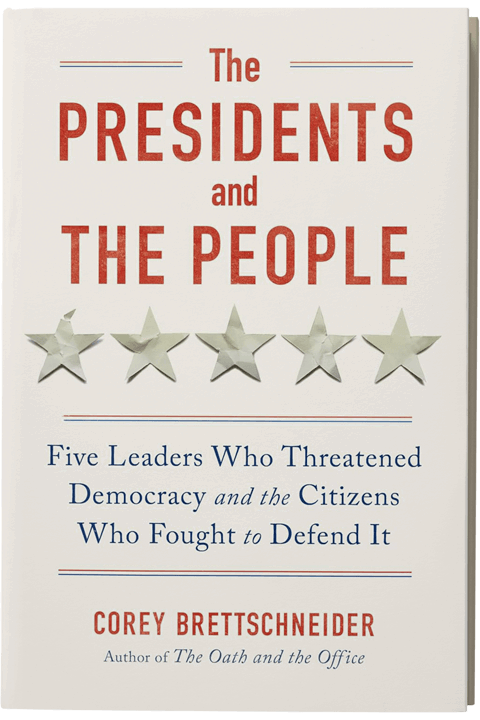
Cover of The Presidents and the People by Corey Brettschneider.

Latest book

The Presidents and the People

Five Leaders Who Threatened Democracy and the Citizens Who Fought to Defend It

By Corey Brettschneider · W. W. Norton · July 2, 2024

Winner, ABA Silver Gavel Award, 2025

American presidents have often pushed the boundaries established for them by the Constitution; this is the inspirational history of the people who pushed back.

About the book

Imagine an American president who imprisoned critics, spread a culture of white supremacy, and tried to upend the law so that he could commit crimes with impunity. John Adams waged war on the national press of the early republic, overseeing numerous prosecutions of his critics. In the lead-up to the Civil War, James Buchanan colluded with the Supreme Court to deny constitutional personhood to African Americans. A decade later, Andrew Johnson urged violence against his political opponents as he sought to guarantee a white supremacist republic after the Civil War. In the 1910s, Woodrow Wilson modernized, popularized, and nationalized Jim Crow laws. In the 1970s, Richard Nixon committed criminal acts that flowed from his corrupt ideas about presidential power.

Through their actions, these presidents illuminated the trip wires that can damage or even destroy our democracy. Corey Brettschneider shows that these presidents didn’t have the last word; citizen movements brought the United States back from the precipice by appealing to a democratic understanding of the Constitution and pressuring subsequent reform-minded presidents to realize the promise of “We the People.”

This is a book about citizens—Frederick Douglass, Ida B. Wells, Daniel Ellsberg, and more—who fought back against presidential abuses of power. Their examples give us hope about the possibilities of restoring a fragile democracy.

“[A]n essential survey… The Presidents and the People is an invaluable breakdown of present-day concerns in an illuminating historical context.”

Publishers Weekly, starred review

“Rarely can a book be called indispensable, but here the term applies.”

Jan-Werner Müller, Princeton University, author of What Is Populism?

“Deeply researched, beautifully written, dramatic, wise, and inspiring—a must-read for scholars, citizens, and anyone interested in how the United States really works.”

James A. Morone, author of Hellfire Nation and Republic of Wrath

“An inspired history dramatically rendered.”

Nancy L. Rosenblum, Harvard University, emerita

On the show

Episodes that draw on the book

Every episode →

Example 2 · Backlist book (Princeton University Press) ↓Same template, same full content: the full two-paragraph description from his site, word for word. The differences: one Amazon button with no "More places to buy", no lede line (his site has no separate tagline), and no reviews block (his site shows none for this book). "On the show" is left out because no episode has been picked for it.
← All books
Cover of When the State Speaks, What Should It Say? by Corey Brettschneider.

When the State Speaks, What Should It Say?

How Democracies Can Protect Expression and Promote Equality

By Corey Brettschneider · Princeton University Press · 2012

Buy the book

About the book

How should a liberal democracy respond to hate groups and others that oppose the ideal of free and equal citizenship? The democratic state faces the hard choice of either protecting the rights of hate groups and allowing their views to spread, or banning their views and violating citizens’ rights to freedoms of expression, association, and religion. Avoiding the familiar yet problematic responses to these issues, political theorist Corey Brettschneider proposes a new approach called value democracy. The theory of value democracy argues that the state should protect the right to express illiberal beliefs, but the state should also engage in democratic persuasion when it speaks through its various expressive capacities: publicly criticizing, and giving reasons to reject, hate-based or other discriminatory viewpoints.

Distinguishing between two kinds of state action—expressive and coercive—Brettschneider contends that public criticism of viewpoints advocating discrimination based on race, gender, or sexual orientation should be pursued through the state’s expressive capacities as speaker, educator, and spender. When the state uses its expressive capacities to promote the values of free and equal citizenship, it engages in democratic persuasion. By using democratic persuasion, the state can both respect rights and counter hateful or discriminatory viewpoints. Brettschneider extends this analysis from freedom of expression to the freedoms of religion and association, and he shows that value democracy can uphold the protection of these freedoms while promoting equality for all citizens.

End of mockupExample 1 ↑ · Example 2 ↑

Design notes

How the template behaves

  • Order on a phone: cover, title, one-line lede, buy buttons, then the full description and the reviews. Buying is never more than a short scroll away. From 760px the cover sits in the left column and stays in view while the text scrolls.
  • One template, full content for every book. Backlist titles get the same description, review, award and related-episode slots as the latest book. A part is left out only when that book doesn't have it. There are no empty headings or "coming soon" lines.
  • Award line. A short text line with a small star under the publisher line ("Winner, ABA Silver Gavel Award, 2025"). It isn't a seal graphic, and it only appears for verified awards.
  • One filled button. The first retailer is the only filled button; three show, and the rest open under "More places to buy". Backlist books usually have Amazon only, so they get one button and no disclosure.
  • The Oath and the Office uses the same template. Its "On the show" lists the show's trailer as where the podcast began.
  • "On the show" is hand-picked. Each book has an optional list of related episodes, chosen by hand in the CMS. Automatic matching would be unreliable. The line under each title is quoted from that episode's show notes. Play loads the episode into the now-playing bar. With no picks, the section is left out.
  • The follow prompt ends every book page, so readers who arrive from search land one step from the show.
  • No sponsor strip (show pages only). No book structured data in the mockup; BookMind handles that in the build.